The Current State of the Thai Economy (BizWings)
Business Opportunities
November 14, 2024 - BizWings (Thailand) Co., Ltd.This article from PrimeGlobal member firm BizWings explores the current state of the Thai economy, the various incentives available to foreign investors, and the risks to know for investors considering Thailand as an entry point to a vibrant Southeast Asian and APAC market.
Access our Business Opportunities Insights hub to access similar articles about international business and global opportunities.
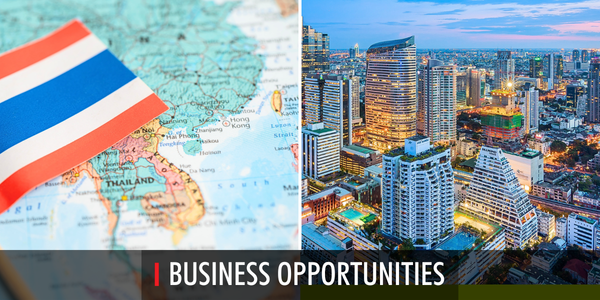
Thailand´s strategic location combined with qualified labor, a secure financial system, and rich cultural heritage makes it an ideal entry point for international investors who wish to enter the Southeast-Asian market. The government of Thailand is offering a series of investment and tax incentives geared towards foreign companies to boost the economy and position the country as an attractive destination for foreign direct investment (FDI). The Board of Investment (BOI) is at the center of this effort through the introduction of enhanced benefits to foreign investors that are aligned with the country's vision for "Thailand 4.0".
This article explores the current state of the Thai economy, the various incentives available to foreign investors, and the risks to know for investors considering Thailand as an entry point to a vibrant Southeast Asian and APAC market.
Current State of the Thai Economy
Thailand has experienced sluggish growth since the pandemic and has not been able to reach its pre-pandemic levels of growth averaging a 4% GDP year-on-year rise. The government is thus seeking to accelerate the momentum of the Thai economy which is currently hovering around 2.5% GDP growth by bolstering key industries and attracting foreign capital.
Overall, the second-largest economy in the ASEAN region has been resilient despite global uncertainties. While the pandemic disrupted key sectors of the Thai economy such as tourism and real estate, the country is on its way to recovery. Economists expect a gradual recovery backed by government stimulus measures and an increase in global trade fueled by the Federal Reserve rate cuts in the US.
The government has announced the start of a large-scale cash handout to Thai citizens which is expected to provide a short-term boost in domestic spending. Furthermore, Thailand is experiencing a rapid shift towards digitization through large-scale investments from major tech players. Google has just announced a USD 1 Billion investment to build a data center capable of servicing the entire region and accelerating the AI transition.
Key sectors driving the growth in Thailand include:
- Manufacturing. Thailand's export is fueled in large part by its automotive and electronics sectors serving as a regional hub. Major car manufacturers have production facilities in Thailand and are investing in the green transition with an increased focus on electric vehicle. Manufacturing accounts for 27-30% of the country's GDP.
- Digital Economy. The pandemic accelerated digital adoption, with e-commerce and fintech sectors experiencing significant growth. The Thai government is actively creating regulatory sandboxes in Thailand regarding cryptocurrencies and centralized blockchain finance to make it a regional hub. This sector accounts for 15-20% of the GDP and is growing rapidly through large foreign investments.
- Tourism. Easing travel restrictions and visa exemptions are reviving this critical sector, which accounted for around 20% of Thai GDP before the pandemic. The government has increased the number of countries eligible for visa exemption from 57 to 93 countries and has made it easier to conduct short business trips in the country.
Government Incentives and Tax Subsidies
The Government of Thailand has provided a broad measure of incentives to reduce operational costs and assist investors in setting up business operations to make the country more FDI
friendly.
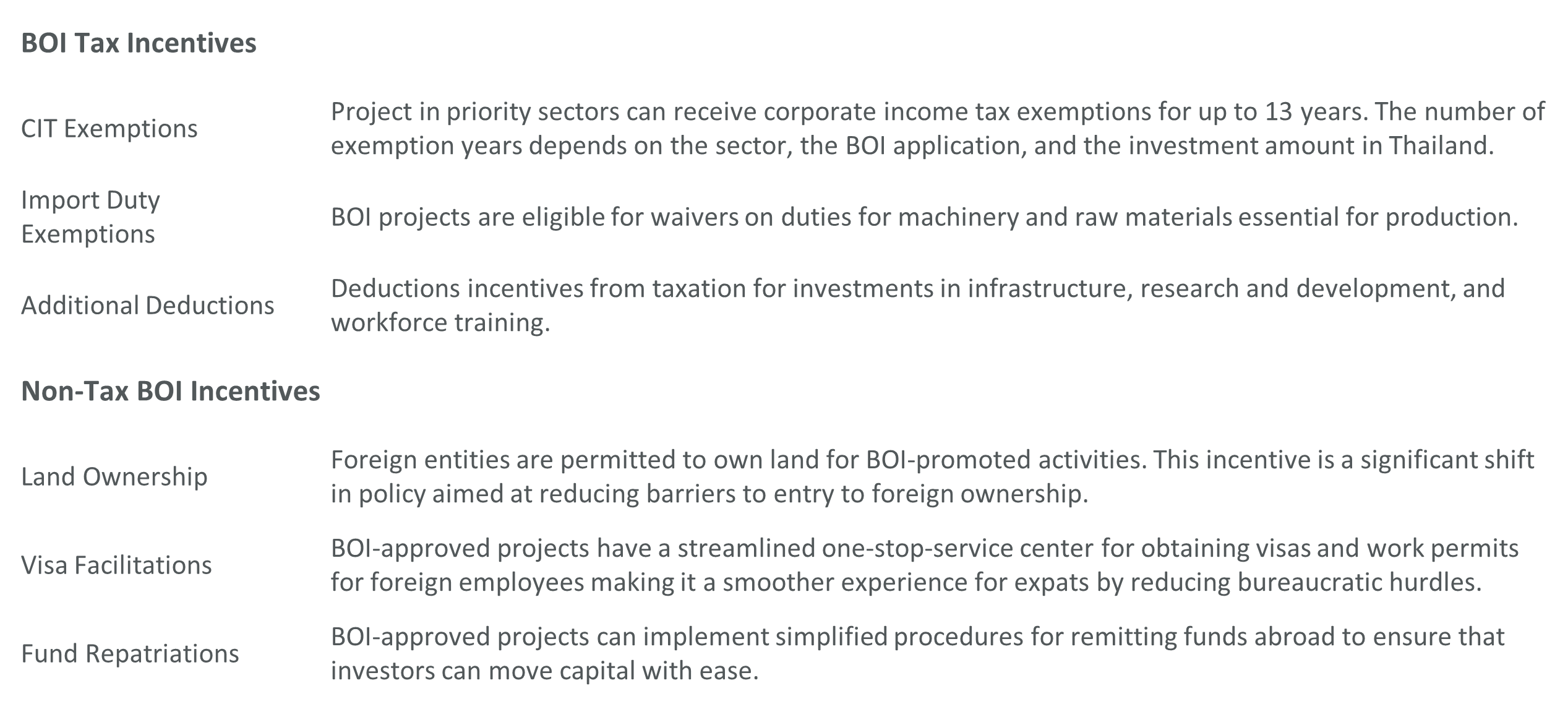
The BOI is the Thai government´s main agency that works on incentivizing foreign investments and plays a pivotal role in promoting investments that align with the country´s economic development plans.
With a broad measure of tax and nontax incentives, the agency aims to attract investments fitting with the "Thailand 4.0" economic model which is a transition toward a value-based and innovation-driven economy.
Key Industries Targeted by BOI Projects
The different incentives and targeted industries are subject to regular changes by the BOI depending on the priority of the government and new technological trends.
- Next Generation Automotive - The BOI encourages the production and development of electric vehicles (EVs), autonomous vehicles, and related components.
- Smart Electronics - The BOI promotes investments in advanced electronics such as semiconductors, microelectronics, and embedded systems.
- Medical Tourism - BOI projects that support high-end tourism services, medical facilities, and wellness centers to cater the high-income travelers.
- Agriculture and Biotechnology - BOI projects that advance modern agricultural practices, biotechnology research, and development of bio-based products.
- Food for the Future - BOI projects that foster innovation in food technology, functional
foods, and sustainable food production. - Robotics and Automations - BOI projects that promote the development and manufacturing of robotics and automation systems for industrial use.
- Aviation and Logistics - BOI projects that support aviation services, aircraft maintenance,
repair and overhaul, and advanced logistics solutions. - Biofuels and Biochemicals - BOI projects that encourage the production of alternative energy sources and bio-based chemicals.
- Digital Industries - BOI projects that facilitate growth in software development, fintech,
data centers, cloud services, and cybersecurity. - Medical and Pharmaceuticals - BOI projects that enhance the production of medical devices, pharmaceuticals, and the provision of comprehensive healthcare services.
Companies looking to invest into Thailand and that are involved in industries pertaining to the above are recommended to pursue their BOI applications to benefit from the numerous
incentives available.
Criteria for BOI Promotion
Companies that wish to qualify for BOI promotion must meet the following criteria amongst others:
- Alignment with National Objectives - project should support Thailand's economic development goals and be in an industry that is supported by the BOI.
- Minimum Investment Requirements - projects must abide by a specified minimum capital investment which excludes land and working capital. In some cases, BOI projects must partner with a domestic company to benefit from the available government incentives.
- Technology and Innovation - projects must commit to using modern technologies and commit to a certain level of R&D which is dependent on the industry of the applicant.
- Environmental Standards - the BOI has recently increased the number of BOI industries that are subject to compliance with environmental protection regulations and sustainable practices.
Additional Non-BOI Incentives
The Thai government has launched several other large-scale incentives for activities not part of BOI-promotion projects. The implementation of Special Economic Zones (SEZs) and the Eastern Economic Corridor (EEC) provides not only substantial tax breaks and import duty exemptions but also grants extended land leases and infrastructure support.
Thailand has also concluded Double Taxation Agreements with over 60 countries to mitigate fiscal burdens. Furthermore, government programs such as the Smart Visa Scheme which simplifies immigration hurdles for foreign talent, and exemptions under the Foreign Business Act open doors in sectors that were previously restricted to Thai nationals. Many government grants, subsidies, and incentives granted under the Revenue Code such as accelerated depreciation and R&D tax deductions can help reduce operational costs.
Navigating Opportunities and Risks
The Thai government has crafted a wide array of incentives extending beyond the offerings of its BOI. The government´s strategy targets various sectors and regions with tailored benefits designed to reduce operational costs, ease regulatory burdens, and enhance profitability for foreign enterprises.
Several risks need to be considered for international investors despite the attractive incentives. Political stability remains a strong concern as Thailand has experienced several sudden shifts in government policies in recent years and is no stranger to political crises and smooth military coups. The overall complexity of Thailand´s legal and bureaucratic landscape can pose challenges for companies unfamiliar with local red tape. Furthermore, infrastructure gaps in certain regions can still affect logistics and supply chains and cultural and language differences might lead to misunderstandings.
Businesses considering entry into the Thai market are advised to conduct thorough due diligence and seek local expertise. With careful planning and an integrated approach, we believe that international investors can navigate the complexities and tap into the promise that Thailand's evolving economic landscape has to offer in the heart of Southeast Asia.
Since 2015, BizWings has helped over 150 international companies in their Thai business ventures. Our expertise in handling corporate matters combined with our advisory capabilities related to business expansion in Thailand enable our clients to navigate the Thai market successfully through an integrated service. We have successfully supported several of our clients in their BOI application process in different industries.
Content by:
BizWings (Thailand) Co., Ltd.
BizWings (Thailand) Co., Ltd., are a professional firm whose services extend beyond a traditional accounting firm. With the aim of providing their client an end-to-end service to support all back office operations, their scope ranges from Online Assistant Service to Accounting and Business Advisory. The firm is fully capable of providing services in English, Japanese and Thai, with remarkable exposure in Japanese business entities in Thailand. Their CEO is the designated advisor to several Japanese governmental agencies including JETRO. BizWings are proud to combine a local expertise with international exposure.
Learn more