
Inbox sanity for client-driven teams
Business Opportunities
February 18, 2026Accounting firms do not lose days. They lose minutes to reply-all spirals, vague subject lines, and messages that bury ownership. Those minutes compound into slower reviews, context switching, and tired teams.
At our annual Tax & Assurance Summit, high-performance consultant Marcey Rader shared email and chat guardrails to fix To/CC misuse, make subject lines decide, and set channel norms that work for partners, managers, and staff.

Why it matters
Client work is deadline-driven. Attention is your scarcest asset. When messages are clear, channels are intentional, and mornings start with focused work, firms reduce rework, move decisions faster, and protect capacity during crunch time. That is sustainable success.
Guardrail 1: To/CC that actually drives action
Misusing To and CC creates invisible work. People scan what’s not for them (or what they perceive isn’t for them). Details slip.
Make this your standard:
- To = the owner(s) who must take the next action. Put a verb in the first line. Example: “Approve client letter by Tue 3 p.m.”
- CC = awareness only. No action expected.
- One thread, one decision. If the topic changes, start a new thread.
- Decision and deadline at the top of the email. Two lines max before the bullets or attachment.
- Name the file version. “ClientA_Q2_TB_v3.xlsx” so reviewers open the right work.
Chat variation: Tag the owner, name the deliverable, and add the due time. Example: “@Alex finalize 990-EZ list by Tue 3 p.m.” Keep side discussions in a thread reply, not a new channel message.
Guardrail 2: Subject lines that decide
If the subject is vague, the work will be too.
Use starters that signal intent:
- Action: Review Q2 trial balance. Due Tue 3 p.m.
- Decision: Choose payroll vendor for Client B
- Info: Updated PBC list. No action
- Approval: Send amended return to client
Two more subject habits:
- Put the client name and period in the subject when relevant.
- If the status changes, change the subject so search results reflect reality.
- Feel it’s pushy or too direct for clients? Add appreciated. Action Appreciated by…
Guardrail 3: Channel guardrails everyone can follow
Right message. Right place. Right time.
Simple norms:
- Email = decisions and documents. Clear ownership. Durable record.
- Chat = coordination. Quick questions, hallway-style updates, thread replies.
- Project tool = tasks and files. Link the task in email or chat so work and context live together.
- Quiet hours for deep work. Choose blocks when messages pause. Leaders model it.
Response expectations: Set them once and stick to them. Example: chat during business hours for quick coordination, email by close of next day for decisions, urgent client issues by phone. Here’s a sample communication matrix you can use as a guideline.
Implementation playbook for mixed seniority teams
1) Pick one team. Pilot for two weeks.
Apply all guardrails: To/CC rules, subject starters, and channel norms.
2) Give examples, not lectures.
- Email template with a verb-first first line.
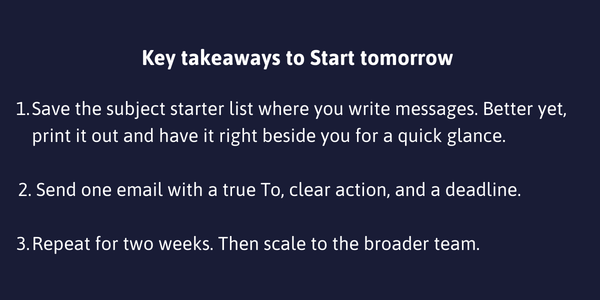
- Subject starter list posted where people write messages.
- Chat examples that show tagging and thread replies.
3) Decide what lives where.
- Task details and files live in the project tool.
- Email captures the decision with the task link.
- Chat points to the task for any follow-ups.
4) Review once, lightly.
At the end of week one, skim three threads and one decision email. Celebrate what’s working. Adjust one friction point.
5) Scale with a page, not a policy.
One page of norms beats a long manual. Keep it findable and short.
Common pushbacks and sample replies
- “Partners need to be CC’d on everything.” CC creates false ownership, inbox clutter, and reduces accountability. It can also feel disempowering if team members feel they can’t be trusted to do the right thing on their own. Use a weekly digest or dashboard for awareness. Keep action with one named owner.
- “Clients may feel we are being too direct (Action:).” Start by using the verbs internally first.
- “I’m going to put the same message in multiple channels because I can’t remember where it goes.” Stop! Create your simple matrix, print it out for everyone, and keep it beside the desk for 30 days to glance at until it becomes a habit.
About the author
Marcey Rader, one of 600 Certified Speaking Professionals® worldwide, is a high-performance speaker, consultant, and coach. She helps firms prioritize first, then optimize what remains through meeting effectiveness, time and attention management, email and chat guardrails, and burnout prevention. Clients range from Fortune 500 to high-growth firms. She hosts the Health-Powered Productivity podcast and is the author of Reclaim Your Workday. Learn more about how RaderCo can help your team with a focused workshop or personal coaching.