
Quick Guide to AI (ACCA)
Technology
November 9, 2023This is a thought leadership article from our Global Strategic Partner, ACCA, uncovering why it's vital for finance professionals to understand the capabilities, limitations and potential applications of AI within their specific domains.
Access our Technology Insights hub to access similar tools and resources to help your firm adapt to current challenges and opportunities that face the accounting and advisory professions.

Artificial Intelligence (AI) is widely predicted to have a profound economic and social impact, transforming industries and enabling a shift to new agendas. Indeed, AI-infused innovation has already produced significant change in our everyday lives and in sectors such as finance, retail and media.
Recent advancements seem to reinforce the transformative potential of AI, with Generative AI widening the scope of short-term applications. On the other hand, this has also brought renewed attention to the serious risks associated with different types of AI and their application.
In such a context, it is important that expectations are tempered. The impact(s) of AI will be diffused across regions and sectors such that there is no one set of rules or solutions that will be applicable to all. The pace of development also underscores the need to remain flexible. As use cases evolve, attention should be focused on establishing a foundation from which to identify real opportunities, assess and manage risks, and implement effective systems and practices for ensuring accountability in the adoption of AI.
Accountability rests at the heart of the accounting and finance profession. We believe that this is a core concept supporting a culture of ethical innovation. Moving forward, however, effective accountability also requires a level of AI literacy. It is vital for finance professionals to understand the capabilities, limitations and potential applications of AI within their specific domains. This may also require closer collaboration between professional accountants, data scientists, and AI specialists.
While new capabilities will transform some tasks, the importance of finance professionals will not diminish. On the contrary, the adoption of AI will only increase the importance of experts such as finance, audit and/or risk professionals to oversee critical processes and functions. Moreover, we envisage a future where accounting and finance professionals are active in the regular evaluation and assessment of AI systems.
Artificial Intelligence is already everywhere
The starting point for any conversation on AI is to recognise that Artificial Intelligence is already mainstream, and it’s a technology that has been transforming our lives for many years already.
It’s in our phones, it’s in facial recognition, its wired into the smart devices in our house such as microwaves, fridges and clever TV’s, it helps us organise our playlists, suggests new music recommendations, and helps us travel from A to B on Google maps.
But what exactly is “AI”?
There’s a saying in computer science that artificial intelligence (AI) is everything that cannot be done yet with machine learning (ML). In other words, it’s all just machine learning.
In general terms, AI often refers to computer systems or machines that can perform tasks typically associated with human intelligence.
In practice, AI/ML are probabilistic, pattern recognition functions that can be used for visual perception, understanding language and speech, prediction, and helping solve other data-related problems. It is also capable of performing these activities and making decisions with a certain degree of autonomy.
What type of AI is currently “out there”?
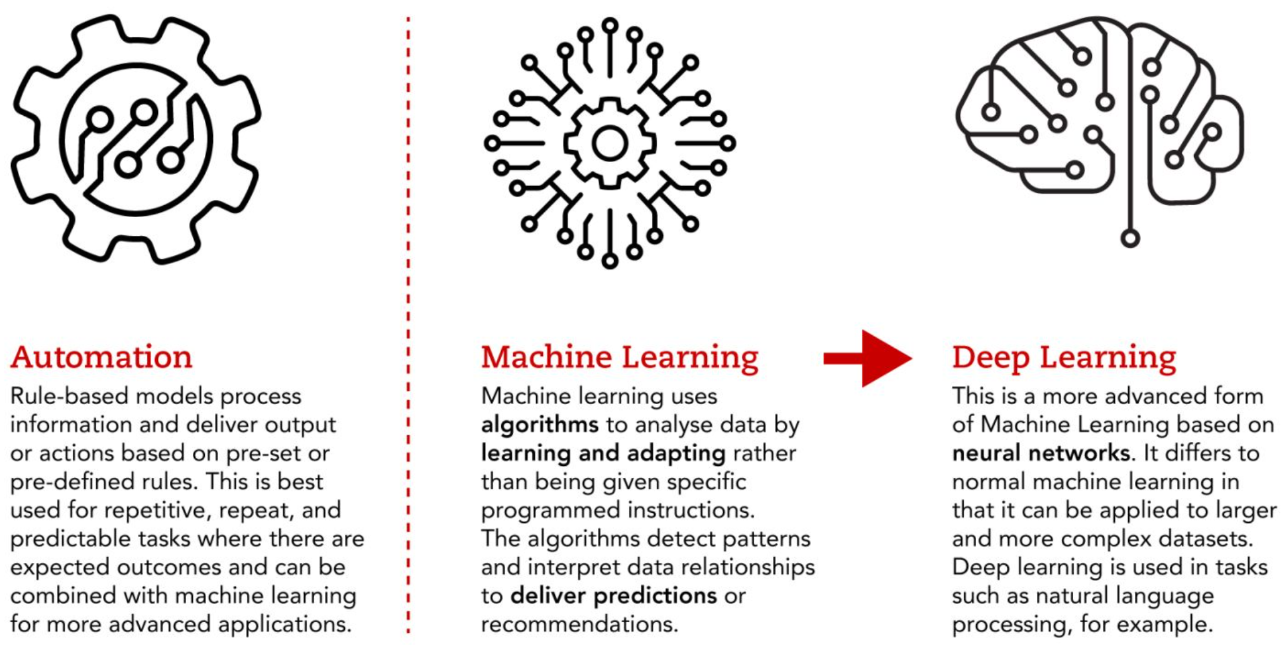
How do machines “learn”?
Whether it is simpler Machine Learning technologies using algorithms to analyse data, or more advanced Deep learning tools and technologies trained on data using neural networks to produce the analysis, they both use a variety of learning techniques to produce their analysis.
Supervised: The machine "learns" by using input data which has already been pre-labelled and/or categorised and may include explicit instructions to identify relationships between variables or identify traits which can then be used to predict or sort new data.
- Example: spam filters are trained to recognise and exclude irregular correspondence.
Unsupervised: The machine "learns" only from the patterns it can see in the existing data – there is no prior labelling of the data or explicit instructions that guide the identification of patterns in large volume of data. Unsupervised learning is less time-intensive, requiring less manual input, but can also be less reliable.
- Example: This mode of training is used for retailer recommendation engines.
Reinforcement: The machine "learns" over time, adjusting its output based on feedback, which can be provided by a human, mathematical function, or both, that reflects the model’s relative performance compared to a set objective. This is a complex form of learning ideally suited to dynamic problems such as resource allocation.
- Example: Predictive text is a good example of NLP using reinforcement learning.
Generative AI, e.g. ChatGPT: what’s all the fuss about?
AI entails the ability to learn the structure of data (including numbers, text, images, chemicals, etc).
With generative AI, we can guide the AI to generate information of different types with control and prompting using natural language rather than computer code.
Foundation models – the basis of generative AI – use a mixture of Deep Learning techniques combining two critical features: language processing at the back-end to analyse data and interpret user prompts and generative capabilities at the front-end to create novel content outputs for text, imagery, or audio data. Generative AI exploits emerging learning approaches to create this new content.
Generative AI: challenges and risks
- Explainability and Transparency: AI systems, particularly deep learning models, are often complex and difficult to interpret. This lack of transparency can lead to the concealment of the decision-making processes and the inherent logic of these technologies.
- Bias and Discrimination: AI systems are not devoid of biases. They can inadvertently perpetuate and amplify societal prejudices due to biased training data. Poor algorithmic design or drift can also result in discrimination. Quality training data is critical, but bias is endemic. Understanding how to manage and counter negative biases is essential.
- Inaccuracy and Misinformation: AI systems are fundamentally probabilistic, meaning they analyse data and produce a response according to patterns and statistical correlations. However, they are not always entirely accurate. One example is known as AI hallucinations, where AI systems confidently assert claims that are simply untrue.
- Privacy Concerns and Security Risks: With the ability to collect and analyse vast amounts of data, AI technologies pose significant privacy and security risks. Data protection regulations and secure data handling practices are crucial to mitigate these privacy risks. AI can be a double-edged sword in the realm of cybersecurity.
AI examples
Accountancy and finance
The current and potential application of different types of AI Models across common accountancy and finance activities is wide. Here are some examples:
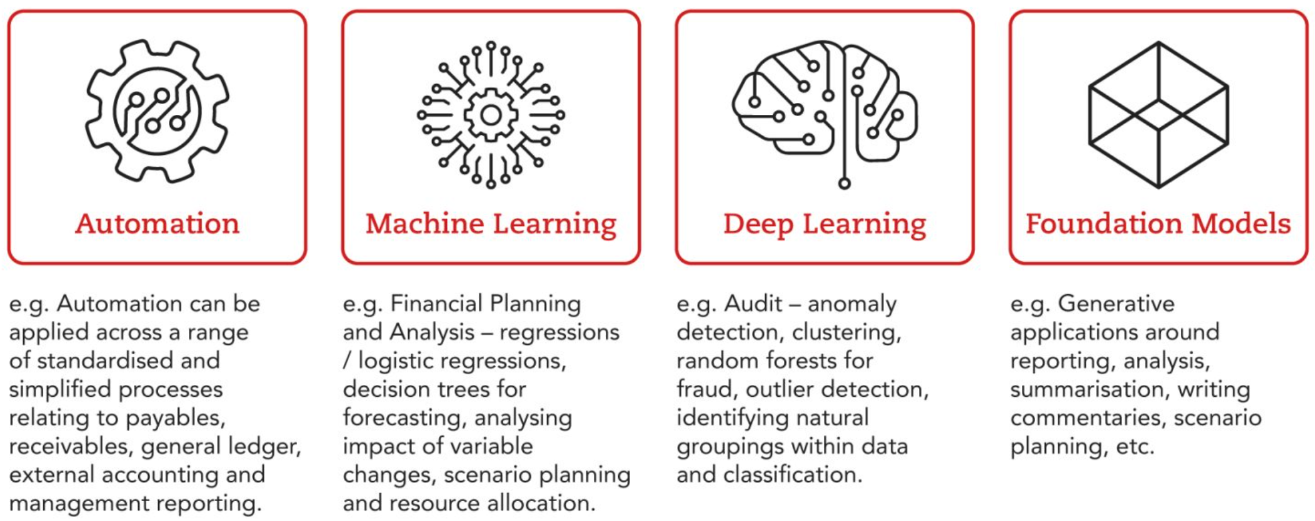
Document summarisation tools
Another good example of the practical use of foundational AI models is their ability to summarise or interpret large amounts of text quickly, allowing users to interact with PDF files written in natural language. Within accountancy and finance, tools such as Claude from Anthropic are becoming increasingly powerful and have a wider range of applications, for example, helping to summarise and interpret accounting standards. It is worth noting that some models perform better at certain tasks over others. For example, models can be designed to better manage the risk of inaccuracy (or hallucination). Nonetheless, this remains a feature of all models that must be appropriately managed.
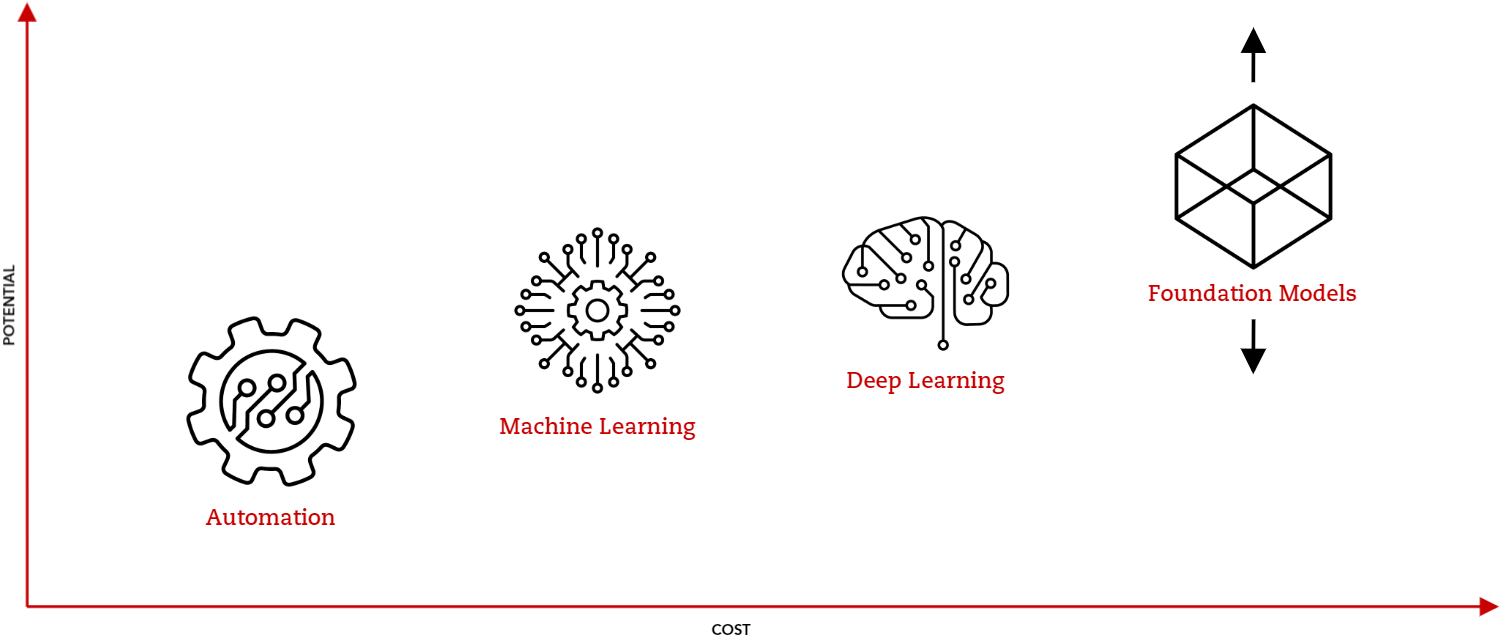
The potential enterprise value of AI
Accountability: finance professionals and ethical use of AI
The adoption of AI models also inevitably introduces ethical considerations and challenges. Finance teams have a critical role to play in helping ensure AI models are used ethically and effectively across the organisation. Here there are two key accountabilities for finance professionals, firstly ensuring they are up to date with the latest developments in AI technologies, and secondly actively collaborating across the organisation with those teams who are driving innovative solutions around this emerging technology.
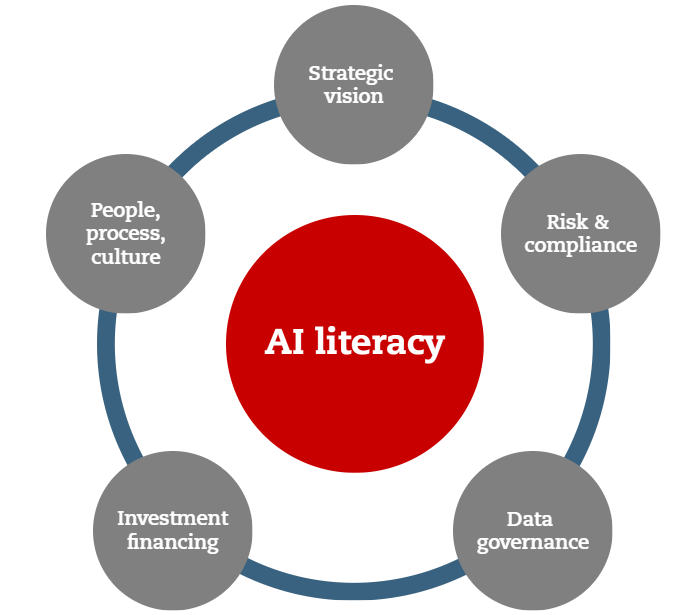
Here are the key priorities for finance teams to focus on in to ensure AI is used ethically across the organisation:
Accountability: finance professionals and ethical use of AI
The adoption of AI models also inevitably introduces ethical considerations and challenges. Finance teams have a critical role to play in helping ensure AI models are used ethically and effectively across the organisation. Here there are two key accountabilities for finance professionals, firstly ensuring they are up to date with the latest developments in AI technologies, and secondly actively collaborating across the organisation with those teams who are driving innovative solutions around this emerging technology.
Here are the key priorities for finance teams to focus on in to ensure AI is used ethically across the organisation:
Ongoing developments for the near future
- Intelligent Process Automation: The integration of artificial intelligence (AI) with robotic process automation (RPA) will improve automation capabilities. This in turn will demand a rethink and redesign of existing accounting and finance processes driving efficiencies and cost savings.
- Enhanced Machine Learning and Deep Learning: AI will test data-driven decision-making, being capable of analysing more and more amounts of financial data to spot trends, anomalies, and insights that humans may miss. This will transform areas such as financial planning, forecasting and business insight.
- Generative AI: Natual language processing (NLP) mixed with generative capabilities will enable new ways of interacting with data and systems, creating new ways of learning, answering queries, generating insights, and completing tasks, particularly as most data held by organisations is typically found in text-based documents.
The big question: AI impact on jobs
- Adaptation: As AI technologies continue to develop and become more efficient, it is crucial for the workforce to adapt and acquire new skills to remain relevant in the changing landscape. AI is an enabler to help to manage growing task loads and work with non-financial data.
- Automation slowdown: Empirical evidence suggests the pace of automation may be slower than had previously expected, and expectations in the level of automation currently have receded slightly according to some commentators, probably reflecting the economic and practical realities relating to cost, effort and skills needed.
- Finance and Accounting Domain experience remains essential: The adoption of AI increases rather than decreases the importance of finance experts to oversee critical processes and functions. AI will not be able to replace the ability to think critically and take into account a broad array of contextual factors when making decisions on the basis of AI-driven insights.
To read the full 'AI in the Finance Profession' report, click here.