
Baseline & Readiness Assessment
Business Opportunities
April 2, 2025 - Schneider Downs & Co., Inc.In this article, member firm Schneider Downs discusses the importance of a Baseline & Readiness Assessment for business owners looking to exit or undergo a transaction. The assessment helps identify key goals, strategic exit alternatives, and opportunities to enhance business value before making a transition. By evaluating both the company's operations and the owner's readiness, the Baseline & Readiness Assessment ensures a well-prepared and successful exit strategy.

Explore more technology resources, including thought leadership and partner content, on our dedicated Business Opportunities Hub.
A baseline and readiness assessment is a critical first step in helping an owner determine whether they and their business are ready to exit or undergo a transaction. It helps define specific goals and objectives for monetization, the strategic exit alternatives available to the owner, and opportunities to enhance value in the business prior to exit. SD Capital’s Baseline & Readiness Assessment comprehensively evaluates the company, including its management team structure and capabilities, organizational structure, financial health, operational efficiency, market/sales positioning, and potential gaps that could lead to discounting in the sale process. The assessment also evaluates the owner’s personal and financial readiness, aligning goals with market realities. By establishing a baseline, owners gain clarity, minimize risks, and create a strategic plan for optimal exit outcomes.
Hypothetical Business Owner
Using a hypothetical business owner, let’s dive into why a baseline and readiness assessment is pivotal for success.
Meet David. He is 62, the business owner of a manufacturing company that fabricates metal products. He started his company in 1981 from humble beginnings, in his parents’ garage with a few industrial machines. Like most entrepreneurs, David struggled to survive the first few years in business, and he stayed afloat. Now, the Company is generating annual revenues of over $25M with $3M in operating income. Over the past five years, he has started to extract value from his life’s work by taking an annual salary with distributions averaging $800K.
David is married and has three grown children. His son, Mark, has been involved in manufacturing and production for three years. David intends to transfer his business to Mark, but he wants to ensure fair treatment for his second son, Joe, and his daughter, Amy, who is not involved in the Company. Over the next three years, David is confident that Mark can transition into the CEO role, allowing him to step back and spend more time with his wife, Susan. David would like to continue earning $800K annually and have Mark buy him out in 2028 at a fair price.
Strategic Alternatives
A Baseline and Readiness Assessment offers David alternative options to make an informed decision vs what he may believe to be the “best” exit option. Here are two potential options for David:
- Intergenerational Transfer to Mark. While an intergenerational transfer may help partially achieve David’s objective, it may not adequately provide for all children or may place stress on the business to support the leverage necessary to achieve David’s desired exit price and timing. Assets outside of the Company may not be sufficient to ensure all children are adequately provided for, and it may not be ideal for Mark to have his siblings as partners in the business once he takes control.
- Third-party Sale. Suppose David could sell his company to a buyer interested in developing Mark. Would he consider a substantial cash payment with potential future earnings—i.e., earn-outs from a successful strategic or financial buyer? How would Mark respond to achieving his father’s retirement goal while simultaneously providing him with additional career development and growth opportunities? A third-party sale could also provide the means necessary to help support David’s other children, without them having to remain minority owners of the business. Consequently, David would receive maximum benefit to support his exit strategy, potentially obtain buy-in from family members while securing his family’s financial future.
Thus, evaluating strategic alternatives performed as part of our Baseline and Readiness Assessment provides David, Mark, and other family members with insights into various options for monetization and their impact.
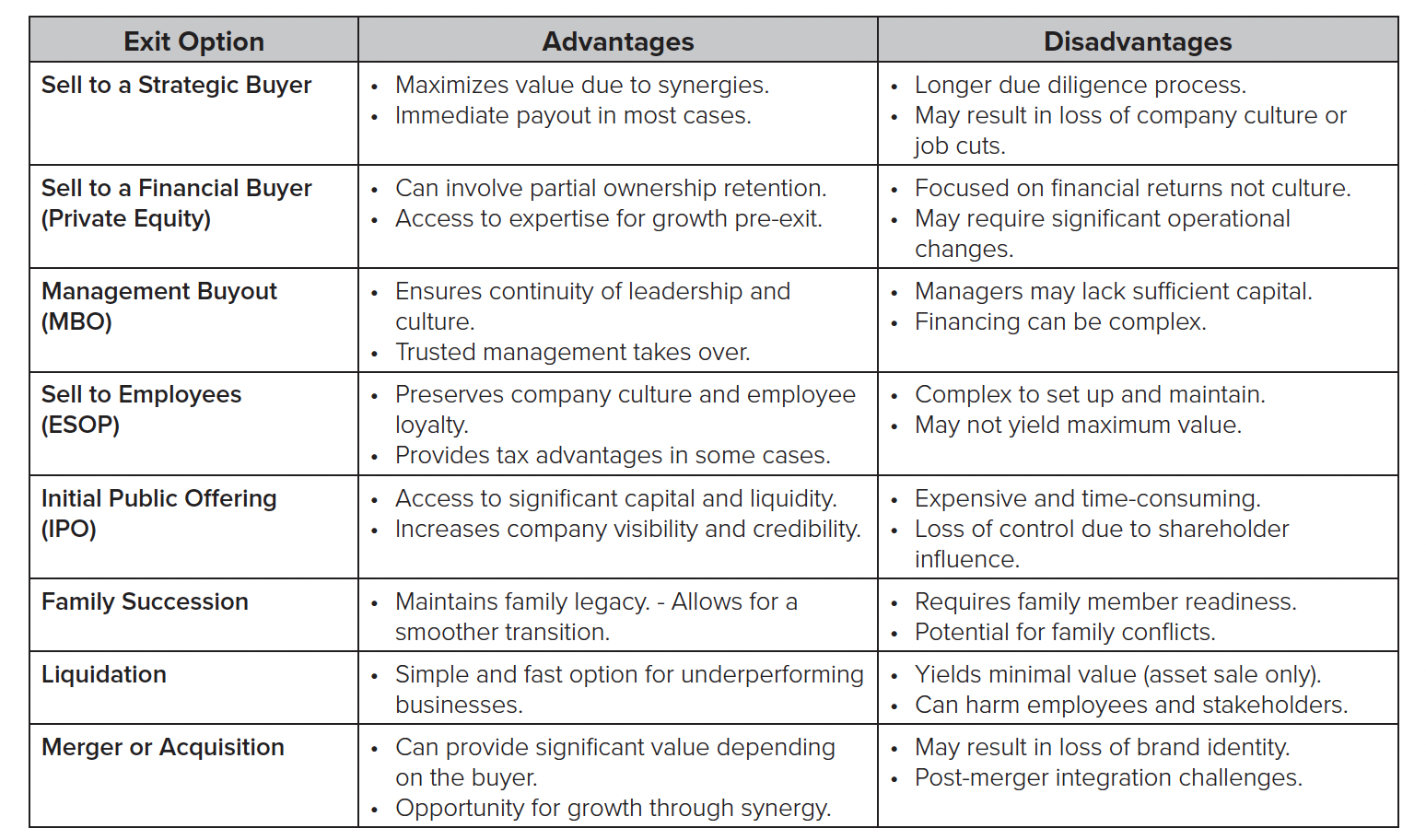
Ultimately, there are many ways to structure a transaction. Any owner’s options will vary based on individual circumstances, goals, and objectives. The following exit options represent a limited number of alternatives we evaluate. Still, it is essential to identify what is in the realm of possibilities and know what is most likely to succeed. An owner’s initial objective for exit may change when they evaluate alternative methods that may drive a greater value and a higher likelihood of success. A partial list of exit options typically evaluated in our Baseline and Readiness Assessment follows.
Transaction Preparation
Maximizing enterprise value and preparing for a transaction in advance is paramount for success. Owners and their management teams become better prepared by imparting knowledge of the transaction process from the assessment.
In David’s case, does he have a formal succession or transition plan to support an intergenerational transfer? If David were to pursue a third-party sale, is he aware of how investors or lenders perceive the Company’s worth? Does he understand how buyers will impair value or discount their purchase price? Are he, Mark, and the management team prepared for the rigors associated with due diligence? Lastly, is David aware of buyers’ strategies to slant the deal in their favor?
A Baseline and Readiness Assessment identifies what can be done in advance. We provide insights relative to the owner’s and company’s ability to navigate a successful transaction. Suggestions are ranked by their impact and timing to proactively address concerns or weaknesses, enhancing a company’s value before pursuing a capital transaction. Furthermore, aligning corporate strategy with David’s personal financial goals, tax planning, and wealth transfer considerations ensures a holistic approach to value creation and maximizing the dollars that flow to David after the sale. Suppose David was to transfer the company to Mark. In that case, the assessment identifies how various business strategies would impact the Company’s future value and mitigate challenges related to growth or downstream transaction obstacles. Proactively managing risks maximizes value and increases the likelihood of a successful transition.
Streamline Operations
If David decides to pursue alternatives other than transferring his business to Mark, a Baseline and Readiness Assessment will help him position the Company for maximum value.
As part of our work, we identify and appraise a company’s value drivers (financial, operational, and technical) to determine what is required to grow and scale successfully over time, including assessing the impact of growth on current infrastructure and team skill sets. Furthermore, we evaluate the strategic positioning of the company for optimal benefit. Our Baseline and Readiness Assessment includes a specific roadmap of tasks and recommendations to optimize growth and profitability, pursue strategic exit alternatives, and remediate value gaps. Additionally, it forms a basis for improved operational and financial performance on a go-forward basis. We leverage our experience to identify potential risks or underperforming areas that can result in slower than desired growth or lower than desired valuation, should you choose to monetize all or a portion of your business in the future.
Streamlining operations in a company requires a comprehensive approach that combines process optimization, technology adoption, and cultural alignment. A thorough assessment of current operations is essential to identify inefficiencies, redundancies, and bottlenecks. This insight allows business owners to make informed strategic decisions, allocate resources effectively, and prioritize growth initiatives. The assessment also highlights areas where process improvements can enhance productivity and profitability.
Based on this evaluation, we recommend implementing lean methodologies, such as eliminating waste and standardizing best practices. Additionally, we explore advanced technologies like automation, customer relationship management (CRM), and enterprise resource planning (ERP) systems to improve efficiency by reducing manual tasks and enhancing data visibility. Specific recommendations are provided to monitor performance improvement with measurable results (e.g., key performance indicators). By integrating these strategies, companies can streamline operations, reduce costs, improve their competitive position, and increase enterprise value.
Risk Mitigation
Companies can mitigate risks by conducting a thorough analysis to identify potential threats, such as intellectual property concerns, transferability of contracts, supply chain disruptions, cybersecurity breaches, market volatility, and regulatory non-compliance. As part of our assessment, we provide insights to prioritize the identified risks based on likelihood and impact. Furthermore, we recommend mitigation strategies such as diversifying suppliers and revenue streams, implementing strong internal controls, and adopting cybersecurity measures to minimize risk. To prevent the impairment of value, we suggest that companies enhance financial resilience by maintaining healthy liquidity, adjusting working capital needs, and managing debt levels effectively.
How involved is David in the day-to-day operations of his Company? What level of ownership does David have over customer relationships and sales? What would happen if Mark took over or departed the Company? How would buyers perceive the risk, and what can be done before pursuing a transaction? We often encourage owners to implement a governance process and delegate responsibilities to minimize owner dependency and flight risk. Limited delegation and lack of governance are major red flags for potential purchase price discounting due to the associated risks. By integrating our risk mitigation suggestions, companies can minimize disruptions, protect assets, and position themselves for sustainable growth.
Benchmarking
As part of our baseline assessment, we analyze how companies benchmark themselves for relative comparisons (i.e., how one company compares against its peer group). We also provide a market assessment to show relative comparisons, trade values, and transaction activity. Additionally, we offer insights and recommendations to implement benchmarking best practices tailored to the specific industry.
Regardless of which direction David chooses, understanding the market, his competitive positioning, and how he is perceived is essential to ensure he remains competitive. Benchmarking and analyzing competitors are critical practices for companies aiming to maintain or gain an edge. Further, demonstrating this capability helps establish credibility with potential buyers because the owner and his management team understand their market, competitors, and customer needs.
Range of Value
In addition to the previously mentioned items, conducting a Baseline and Readiness Assessment helps a business owner determine the company’s worth. We provide an indication of value based on the information received and relevant market data. Typically, we establish a range of value using market multiples of adjusted earnings before interest, taxes, depreciation, and amortization (EBITDA) or revenue.
For David, a crucial aspect of obtaining a reasonable estimate of value is ensuring that the information used to derive EBITDA is based on financial statements prepared in accordance with Generally Accepted Accounting Principles (GAAP). Market multiples associated with EBITDA are generally based on GAAP-compliant figures. Additionally, companies with audited financial statements typically face less resistance from potential buyers during the sale process and financial due diligence.
If David is selling to a third party, he should also consider undergoing a sell-side Quality of Earnings (QoE) analysis. This process provides additional validation of the numbers, including adjusted EBITDA. It helps facilitate a smoother, more successful transaction at a higher valuation by mitigating unexpected issues and instilling greater confidence in the financial data.
There may also be instances when a formal valuation is beneficial, such as when buying out minority partners or supporting gifting or other pre-sale strategies. Ultimately, establishing a value range helps business owners set realistic expectations, negotiate confidently, and avoid undervaluing or overpricing the company.
Summing it Up
A company is typically a business owner’s most valuable asset. Preparing for downstream monetization and understanding when and how that is to occur is key to ensuring that an owner achieves maximum value. The Baseline and Readiness Assessment is the first step in this process. It helps to protect and enhance value in anticipation of exit.
Content by:
Schneider Downs & Co., Inc.
Schneider Downs is a top regional accounting and business advisory firm located in the northeastern part of the United States with a significant international reach. For more than 60 years, we have provided professional services to public and private companies, nonprofit organizations, professional associations, service firms and government entities across the United States and around the world. We have more than 500 employees and 56 shareholders and offer more than 100 services with dedicated teams from four business units: Tax, Audit, Consulting and Wealth Management.
Learn more