Smarter Hiring: How AI Can Help CPA Firms Win the Talent Game
Talent Development
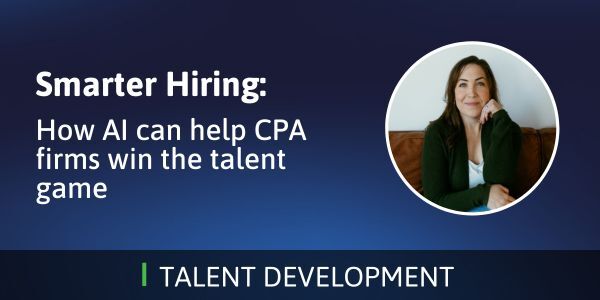
July 30, 2025With the talent market constantly shifting, many CPA firms are wondering how to stay ready, especially as hiring slows. Rachel Biggs, founder of Good Works Talent and featured speaker at PrimeGlobal’s upcoming MegaWeek 2025 event, believes now is the time to rethink how we recruit. In this article, she shares how firms can use simple tools and smart strategies to build a faster, fairer, and more resilient hiring process - no tech overhaul required.
A year ago, I found myself sitting in a room of fellow recruiters and HR professionals, staring down a question I suspect many of you are asking right now: What am I supposed to do about AI?
I wasn’t afraid it would take my job. I was wondering how to make it help me do it better. I had more roles to fill than people to fill them, more deadlines than recruiters, and a growing sense that traditional hiring simply was not keeping up with the talent landscape.
Today, many CPA firms are facing a different, yet familiar, challenge. With the market softening, recruiting demand may feel quieter than usual. Some firms have trimmed their HR or recruiting teams, reallocating resources until hiring picks back up. But we who have seen a few cycles know what’s coming. Recruiting is cyclical. The hiring needs will return, as they always do. And when they do, the pressure to deliver—quickly and effectively—will be even greater.
That’s why now is the time to retool. If your team is leaner, AI and automation can help you do more with less. And if you're one of the many firms thinking about how to prepare for the next wave of hiring, the decisions you make now could determine your competitive edge later.
The Shift from Traditional Recruitment to AI-Enabled Hiring
Traditional methods—job boards, cold outreach, and referrals—aren’t built for the pace or precision today’s market requires. Top candidates are available for only about 10 days, yet the average time-to-hire sits around 47 days. Hiring managers are frustrated. Recruiters are stretched thin. And some of your best potential hires are slipping through the cracks, unnoticed.
This is where AI becomes a practical advantage, not a theoretical one.
Big Four firms that are already integrating AI into their hiring workflows are seeing significant improvements.
- PwC reduced time-to-hire by 54 percent through automation.
- KPMG cut their time-to-hire by 20 percent and saw better retention.
- EY created a virtual AI interviewer to help prepare candidates and reduce anxiety.
Even small to mid-sized CPA firms are seeing results. One client of ours began using AI to actively source and engage high-quality passive candidates instead of relying solely on inbound applicants. They are now building pipelines with hundreds of candidates, not just filling vacancies.
What AI Actually Does for You
AI does not replace your recruiting team. It supports them by taking on the repetitive and administrative tasks that drain time and energy.
Here are a few examples:
- Smarter sourcing using tools that locate qualified passive candidates across platforms.
- Automated outreach through consistent, personalized messages at scale.
- Candidate screening based on experience, qualifications, and performance indicators.
- Interview support with structured questions, scoring guides, and data-backed assessments.
If your team is smaller than it used to be, or stretched thin across multiple roles, automation can give you capacity you didn’t think you had.
Introducing PBHGpt: Performance-Based Hiring, Powered by AI
One tool gaining attention is PBHGpt, an AI-powered assistant built around Lou Adler’s Performance-based Hiring methodology. I personally use it almost daily. It guides users through the full process—from writing outcome-based job descriptions to sourcing strategies, structured interviews, and final candidate assessments. The tool is designed to help hiring teams reduce bias, improve consistency, and focus on long-term fit by aligning every step of the process with measurable performance objectives.
If you're already familiar with Lou Adler’s framework, PBHGpt can help bring that structure to life in a modern, AI-supported workflow. And if you’re exploring performance-based hiring for the first time, it’s a hands-on way to test the approach.
The role and process customization that previously took firms several weeks now takes 20 minutes. If you’d like to see how it works, feel free to reach out. I’m happy to demo or share a sample job profile and scorecard to help you explore whether it might be a helpful tool for your firm.
Ethics and Efficiency Can Coexist
As CPA professionals, we are trained to uphold high standards. AI in hiring must meet those same expectations. The tools I recommend are built with fairness and compliance in mind. They avoid bias-triggering data points like names and addresses and focus solely on relevant skills and experience.
Security and transparency are also critical. Look for platforms that anonymize data, encrypt everything end-to-end, and provide clear audit trails. If you are unsure about a tool, your IT or managed service provider should be part of the vetting process.
Used correctly, AI can make your hiring process not only faster and more efficient, but also more equitable.
Getting Started with a Lean Team
You do not need to invest in a full tech stack or overhaul your entire process. Start small. Choose one step in your workflow that feels slow, manual, or inconsistent. That might be sourcing, scheduling, or screening. Then test a tool designed specifically for that need.
The key is not to do everything at once, but to focus on where AI can give you the most leverage with the team you have today.
Looking Ahead
Hiring may be down now, but it won’t stay that way. When the market turns, CPA firms that have adopted smarter systems will move faster, attract better candidates, and keep growing. Whether your team is full-strength or operating lean, AI can help you hire more strategically, not just more quickly.
This is not about chasing the latest trend. It is about building a repeatable, reliable system that helps your firm thrive—now and into the next cycle.