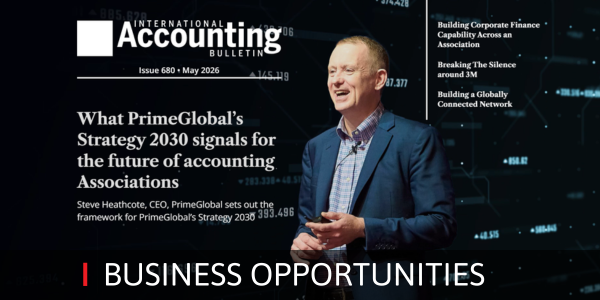
What PrimeGlobal’s strategy 2030 signals for the future of accounting associations
Business Opportunities
June 12, 2026This article first appeared in the IAB magazine in May 2026.
As the accounting profession undergoes rapid and sustained transformation, global associations are coming under increasing focus and scrutiny. Member firms are asking more direct questions: what tangible value does an association deliver, how does it support growth, and how can its impact be evidenced?
At the same time, the environment in which firms operate is shifting quickly. Artificial intelligence is reshaping service delivery, client expectations are moving towards insight-led advisory, and firm structures are evolving through consolidation and investment.
In this context, strategy cannot be a high-level statement of intent. It needs to be practical, measurable, and clearly linked to outcomes at the firm level.
PrimeGlobal’s Strategy 2030—“Ready for Business”—offers an example of how one association is responding to this challenge. Rather than treating strategy as a document, it has approached it as a system for learning, capability building, and measurable progress across its membership.
The positioning of “Ready for Business” is deliberate. It reflects a shift from strategy as direction-setting to strategy as a framework for action, focused on ensuring firms are equipped to respond to change and capture new opportunities in real time.
From consultation to co-creation — and firm-level impact
Consultation is standard practice in association strategy. PrimeGlobal followed this process, engaging widely across its membership base, including numerous survey responses and extensive regional and board-level discussions.
What is different is what came next.
Member firms were not only asked what they wanted from the association; they were asked how they were adapting their own businesses—where they were investing, what was working, and where they were seeing growth, particularly in advisory and technology-enabled services.
This input directly shaped the structure of the strategy, which is built around three clear themes: build capability, drive opportunities, and activate community.
An important outcome of this process was its effect on the firms themselves. A number of firms reported that engaging in the development of the “Ready for Business” strategy prompted them to reassess their own direction—not just in response to change, but in how they viewed it.
In a profession where developments such as AI, new ownership models and shifting client expectations are often seen as disruptive, the process helped some firms reframe these pressures as opportunities for growth—particularly in advisory services, new markets, and more modern operating models. Some refined existing strategies; others began formalising one for the first time.
This is significant. Outside the largest firms, structured strategic planning is not always prioritised. The process therefore created value in itself—helping firms move from reacting to change to thinking more proactively about how to shape it.
A three-way model: insight, activation, and firm-level change
This leads to what could be described as a three-way model for strategy.
- Firms → Association
Firms contribute practical insight on how the profession is evolving—particularly in areas such as advisory services, AI adoption, and new business models.
- Association → Firms
The association translates this into structured opportunities—through communities, tools, and programmes—that help firms act on those insights.
- Firms → Their own strategy
Participation in this process leads firms to refine or develop their own strategies, creating a second-order effect beyond the association itself.
This is a more dynamic model than traditional strategy cycles. It is not just about alignment; it is about continuous learning and application at multiple levels.
Linking strategy to measurable outcomes
A consistent challenge for associations is demonstrating impact. Many strategies describe ambitions—advisory growth, digital transformation—but stop short of defining how success will be measured.
PrimeGlobal has taken a more explicit approach.
Its Strategy 2030 sets clear, long-term targets linked to member firm outcomes, including significant growth in advisory services and improvements in firm scale and engagement. These targets are phased, with mid-point reviews and annual operational measures to track progress over time.
What is notable is that these are not framed as internal KPIs. They are framed as indicators of member firm success—for example, increasing advisory revenues and strengthening firm capability in higher-value services.
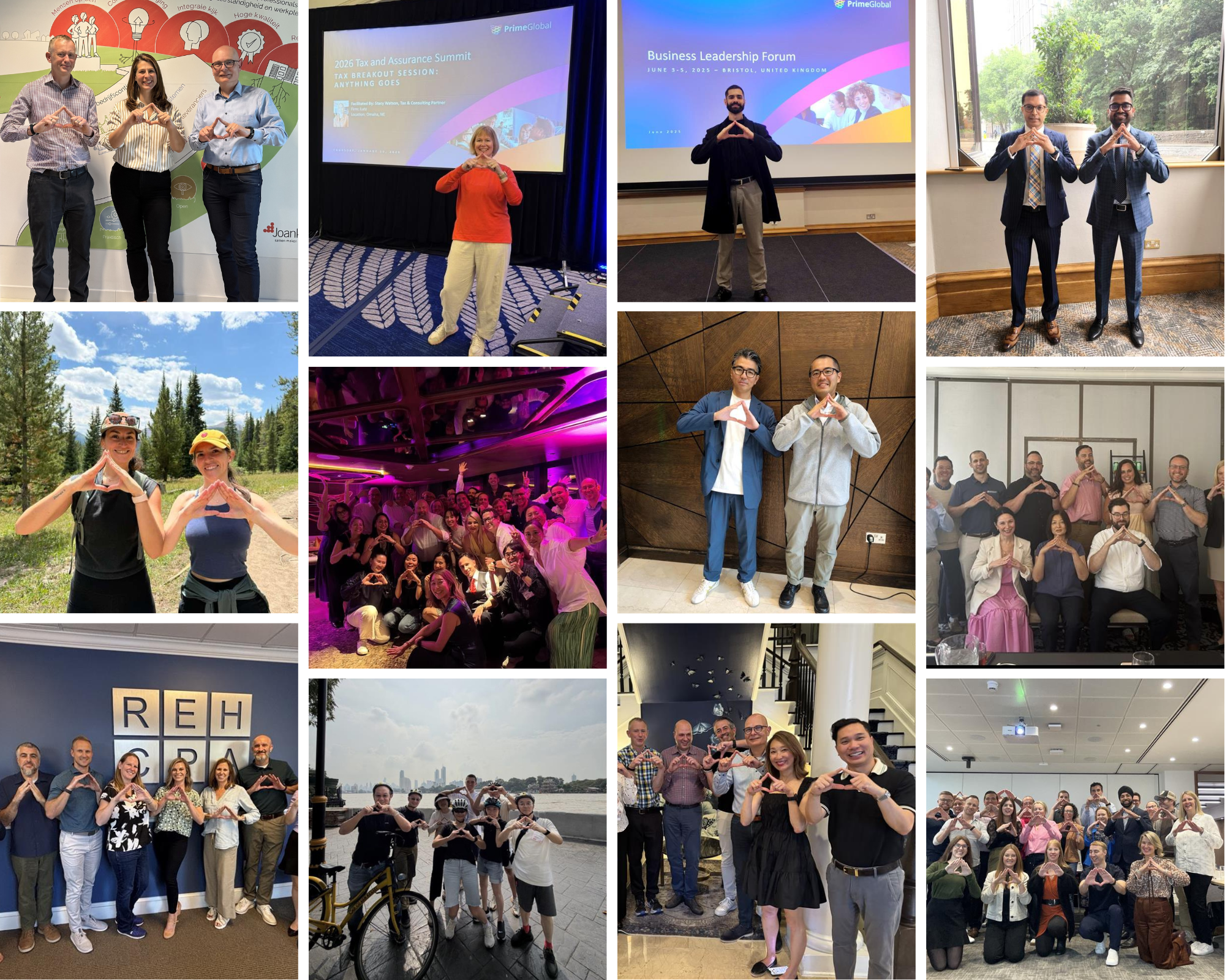
Clear, shared measures bring the strategy to life. By making the indicators visible to all members, staff and firms work side by side across the association, able to see whether we are winning and step in to help move the dial—whether increasing the share of revenue from advisory services or deepening engagement across firms.
This reflects a different level of accountability. Strategy is not just about delivering activity; it is about demonstrating that firms are progressing as a result.
Using data and platforms to shape and deliver strategy
Another distinctive element is the role of technology.
PrimeGlobal has invested in its digital platform, MyPrimeGlobal, built on a complex CRM infrastructure. This allows the association to track engagement and firm growth at a much deeper level—understanding not just which firms are involved, but how professionals across those firms are interacting, collaborating, and contributing, and how firms are evolving and growing as a result.
This data has been used both to inform the “Ready for Business” strategy and to deliver it in practice.
- It provides insight into where engagement is strong and where it is limited
- It helps identify firms that may need more targeted support
- It enables more relevant connections between firms based on capability and need
Importantly, it also allows PrimeGlobal to take a more proactive role—bringing firms together around specific opportunities and stepping in to help drive collaboration and outcomes, rather than relying on a purely reactive association model. The strategy is also more segmented to increase impact, targeting support to specific member needs.
The platform is not positioned only as a communication tool, but as infrastructure for collaboration and insight. Combined with mobile access and community functionality, it allows strategy to be embedded into day-to-day activity, rather than remaining a periodic initiative.
Designing for capability, not just direction
A further lesson from PrimeGlobal’s approach is the importance of focusing on capability.
The strategy places strong emphasis on helping firms:
- develop advisory services beyond compliance
- build leadership capacity
- adopt AI and technology effectively
- collaborate to access new markets and opportunities
This is aligned with wider trends in the profession. As outlined in the strategy, technology and talent are the two central drivers of change, shaping both how firms operate and the value they deliver to clients.
A key part of the strategy is building leadership capability to ensure the next generation of leaders can guide their firms through a period of significant change. We engaged this group directly in shaping the strategy and will continue to listen through a new forum. Alongside this, there is a clear focus on expanding leadership capability—for example, through a global partnership with Vistage, the world’s largest CEO peer advisory organisation, launched earlier this year.
The role of the association, therefore, is not just to identify these trends, but to help firms act on them in a structured and practical way.
Implications for associations
Every association operates in a different context. However, there are some clear lessons from this approach.
- Make strategy a learning process, not just an output
- Link strategy to firm-level outcomes
- Use data to understand engagement and impact
- Embed strategy into platforms and communities
- Focus on capability building
These are not theoretical considerations—they reflect how associations can remain relevant in a more demanding environment.
A more accountable model for associations
PrimeGlobal’s Strategy 2030 reflects a broader shift in expectations.
Associations are no longer evaluated solely on connectivity or brand. They are increasingly expected to demonstrate how they help firms navigate fundamental shifts—such as moving into advisory, managing succession, and driving broader transformation to support long-term growth.

“Too many strategies describe where an organisation wants to go, but not what will change as a result. ‘Ready for Business’ starts from a different place—defining the outcomes we our firms need to see and building everything around that. If we cannot evidence impact, then we are not delivering on our role as an association.” Gorana Stojanovic, Executive Director of Strategy, Planning & Impact
Looking ahead
Our firms are operating in a profession that is changing quickly—towards advisory, technology and new business models. ‘Ready for Business’ is about ensuring they are equipped to lead that change, not just respond to it, by building the capability and connections they need to grow.
As the profession continues to evolve, associations will need to adapt their models accordingly. PrimeGlobal’s Strategy 2030 provides one example of how this can be approached—by combining insight from firms, structured activation through platforms and communities, and a clear focus on measurable outcomes.
For associations considering their own direction, the key question may not be what strategy should say, but how it can be designed to drive real change for their member firms.
In a more demanding and fast-moving environment, that distinction is likely to matter more than ever.