Own Your Intelligence: The Decision Every Firm Needs to Make Before 2027
Technology
November 12, 2026 - SPNXFollowing the recent AI 2026 to 2027: Learnings, Case Studies, Implementations & What's Next webinar hosted by PrimeGlobal and SPNX, this article explores why the firms that gain the greatest advantage from AI will be those that own and develop their institutional knowledge, data, and firm intelligence. Drawing on insights from SPNX and industry leaders from Boulay, Pinion, and Buzzacott, it offers practical guidance for firm leaders preparing for the next phase of AI adoption. We thank SPNX for sharing this thought leadership piece with the PrimeGlobal community.
Two firms subscribe to the same AI on the same day, at the same price. A year later, one is getting twice the output it started with and the other is getting a hundred times more. The model is identical. The difference sits in what each firm has connected to it, and that gap is about to decide which firms lead the next decade.
Everyone is Renting the Same Brain. You Must Own Yours!
For most of history, intelligence came packaged in people. Firms hired it and billed it by the hour. Since November 2022, intelligence has been available as a service, on demand and priced by the token, to every firm at once.
Anything every firm can rent gives no firm an edge. The rent is also rising: enterprise AI licences now carry usage charges on top, and the pricing changes often.

"Intelligence as a service is giving us this incredible capability almost out of the box. But it also is creating a liability, in that vendors who are offering intelligence as a service have so much leverage." Luke Muszkiewicz, Technology & Data Expert, Pinion Global ~ At the AI 2026 to 2027 Webinar (NA/LA session) by PrimeGlobal and SPNX
The pace makes the choice urgent. In 2022, leading models could work on a task for about 36 seconds before losing the thread. Today they sustain work for 16 hours or more. A year of waiting now spans several generations of capability.
So the question for every managing partner is simple. What does your firm own?
Owning Your Intelligence Starts with Memory
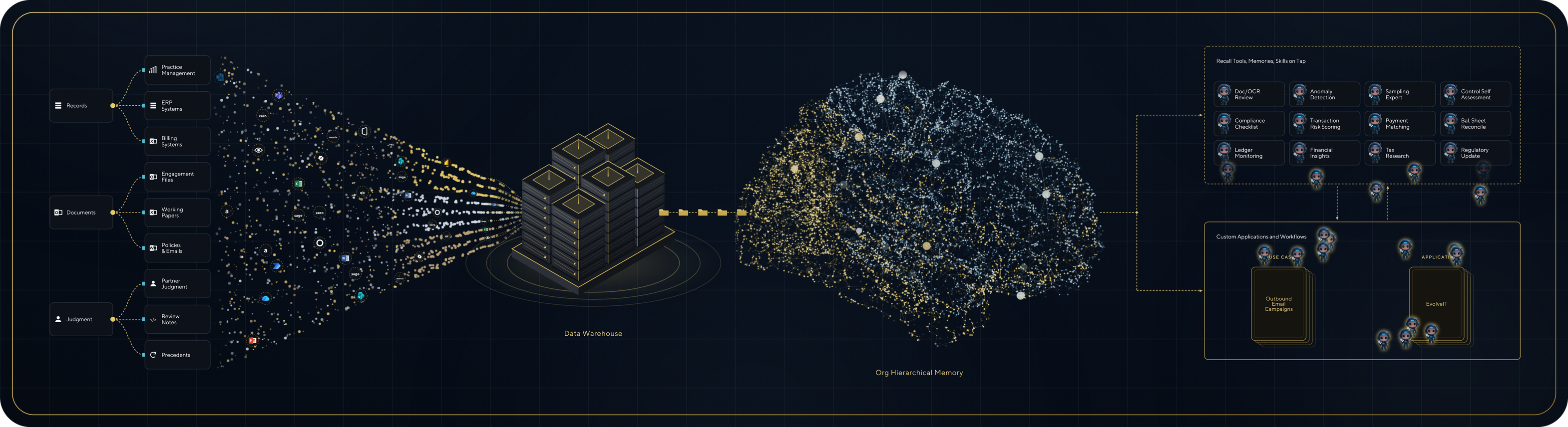
The answer starts with firm memory, built as an Organizational Hierarchical Memory (OHM).
A person can hold about seven things in mind at once, which is why firms run on checklists and org charts. An AI can hold several books in a single view. What it lacks is the firm's own context: its emails, meetings, work papers and the judgement behind past decisions. With that context, the same rented model works like a senior member of staff.
OHM organizes that context the way the firm itself is organised. Each person and team has its own layer of memory, and those layers roll up into one brain for the firm. Inside it, a written skill works like a trained staffer and a routing table mirrors the org chart. Access follows the hierarchy too, so a partner can see what their team knows while client files stay separated from one another.
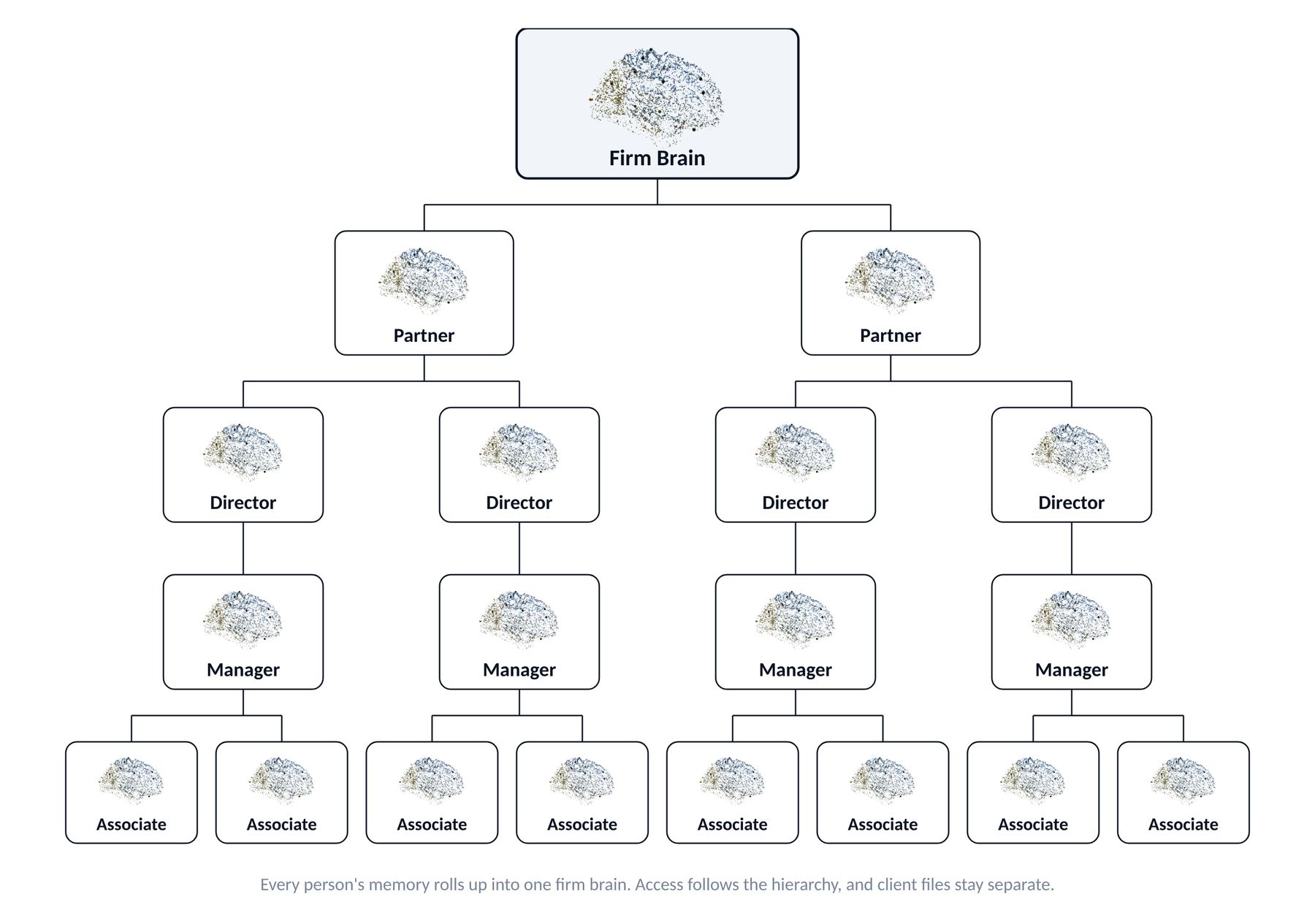
It compounds, because every solved problem is saved and improved. It is portable, because it lives in plain, AI-readable text files the firm controls, so it moves with the firm from one AI platform to the next without anyone's permission.
"So much of it is ultimately a simple markdown text file. The more you can make sure those assets are stored and controlled separate from the vendors you're working with, the more power you have to make those kinds of decisions about moving to different platforms." Luke Muszkiewicz, Pinion Global

"The most valuable knowledge that all of us have is what's in our heads. There's so much institutional knowledge that is lost when somebody retires. Once you've done that initial transfer, it's just maintaining and updating." Peter Anderson, Chief Information Officer, Boulay, at the same session
Underneath, a firm's records and documents are governed in one data warehouse, with OHM built on top and agents drawing from both. This AI BrainFrame is the architecture of a Synthetic Intelligence Layer, where the intelligence a firm builds stays with the firm.
Where that Intelligence Runs, and Who Designs It
Owned memory pairs with owned compute. Small language models that run on a firm's own hardware already exist, and most accounting work is structured enough for them. As this edge AI matures through 2027, running models locally keeps client data inside the firm's walls and keeps costs predictable.
People make it work. The firms moving fastest have partners who step back from doing the work in order to design it, and system thinkers who turn that design into skills and memory. Once that groundwork is in place, agents become practical. Some firms already have agents resolving routine IT issues before they reach an engineer, while others use swarms of agents that sample transactions and escalate only the exceptions for a reviewer to judge.
Building It Without Losing It
Vibe coding has solved the oldest problem in custom software, which was never the code. It was explaining what you wanted. Today the person who knows a process best can describe it in plain English and have a working prototype by the afternoon.
That prototype covers roughly 25% of a production application, and it is the part only the firm can get right. The other 75% is architecture, integrations, access rights, testing and the controls a SOC audit will expect. Without that hardening, good ideas never go live, and the system thinkers behind them stop building.

"What looks like 80% is actually 25%, but this 25% is the most important for success or failure." Karan Gupta, Chief Vision Architect, SPNX ~ At the AI 2026 to 2027 Webinar (NA/LA session) by PrimeGlobal and SPNX
Off-the-shelf platforms make a sound backbone for the ledger, the tax engine and practice management. As prices rise and some vendors ask for a share of revenue, the contract carries the weight: the firm owns and can export its data, and price rises are capped. Building in-house under a CTO takes about two years to pay back and returns the most. A fractional CTO or specialist partner who knows accounting gets there faster, building the firm's memory alongside it so the intelligence it creates stays its own.

"You don't want to hand over the accountability for the decision-making… you're still responsible, and you still own that data in your own environment." Amar Kanabar, Tax Leader, Buzzacott ~ At the AI 2026 to 2027 Webinar (EMEA/APAC session) by PrimeGlobal and SPNX
Buy the backbone, build the edge, and keep ownership of the firm's data and memory in every contract.
The worst thing you can do right now is have decision paralysis
Four moves can get you started this quarter:
- • Put data governance in place, so every later step has a safe foundation.
- • Sit with your most senior partners and write down the first ten skills only they know.
- • Review every AI contract for data ownership, price caps, training rights and exit terms.
- • Name one owner for the firm's intelligence, whether a CTO or a specialist partner.
The firms that own their intelligence will set the pace for 2027, and the work starts now.
Watch the full panel discussion from AI 2026 to 2027: Learnings, Case Studies, Implementations & What's Next, held with PrimeGlobal, in the NA LA session or the EMEA APAC session. To explore what owning your intelligence looks like for your firm, visit spnx.ai.
Content by:
SPNX
SPNX is an AI-native, multi-disciplinary consulting and outsourcing firm, built for a world where intelligence is becoming core to enterprise operations. Established in 2016, the firm operates on an Outcome-as-a-Service (OaaS) model, combining consulting, technology, and managed services to design, deploy, and deliver intelligence across the value chain.
Learn more