Reflections on 2025
Business Opportunities
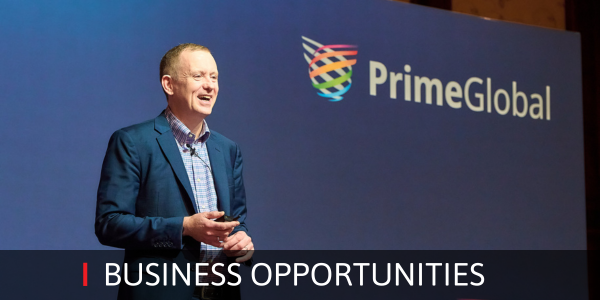
December 22, 2025In this article, which was first submitted as an interview for the International Accounting Bulletin (IAB), PrimeGlobal CEO Steve Heathcote reflects on a year of growth and change for the association.
Change and growth in 2025
2025, the final year of our Strategy 2025 – Building our Future Together, was our strongest year yet. PrimeGlobal member firms grew combined revenues by 19% to a record US$6.4bn. We now unite 316 firms, over 53,000 people and 1,271 offices in 120 countries, having added seven new countries. Asia Pacific was our fastest-growing region with 61% fee growth, while North America and EMEA also delivered large absolute revenue increases.
Over the life of the Strategy, advisory-related revenues have doubled, and in 2024/25 accounting services revenue rose by 30%, while tax remained the largest service line.
Growth is being driven by firms broadening their advisory, ESG and technology offerings; stronger cross-border referrals supported by our global platform; targeted recruitment and M&A. Member satisfaction has reached a record 88%, with a Net Promoter Score of +43, underlining that listening and responding to member needs is translating directly into sustainable growth.
A year of investment in technology
Technology and AI are central to our value proposition. We have expanded MyPrimeGlobal as the digital home of our community, doubling users since the start of the 2025 Strategy and adding functionality that lets firms see which technology providers other members use, saving significant time in procurement and accelerating best-practice sharing.
We’ve also enhanced online referral, profiling and multilingual website capabilities so that members can more easily find specialist expertise and collaborate across borders.
Looking ahead, we are investing in a new collaboration platform and mobile app, launching in early 2026, to support richer member forums and interaction, Communities of Practice and real-time resource sharing around major events.
Strategically, PrimeGlobal has become one of the first associations to form global AI partnerships with DataSnipper and Suralink, giving member firms preferential access to next-generation audit automation and client collaboration platforms, backed by user groups, webinars, an AI Hub and extensive thought leadership on AI in accounting.
Advisory
How are your firms addressing regional variances in advisory demand, and which industries or client segments are driving growth or facing challenges?
North America continues to see strong growth in wealth management, now the largest service outside tax, assurance, and accounting. Fractional CFO/payroll services are also gaining momentum as clients seek flexible senior finance support.
Despite softer conditions, Corporate Finance and M&A remain priorities globally, with firms helping clients sell, acquire, and expand businesses
In Asia Pacific, firms advise on tariff impacts and supply-chain shifts, with production increasingly moving to ASEAN countries.
Technology advisory is accelerating in North America and EMEA, driven by AI governance and cyber security risk.
Sustainability services have declined, particularly in Europe, though many firms still support sustainability improvements.
With advisory services increasingly tech-driven, how are firms balancing innovation with the need for a personalised, client-centric approach?
Where possible, firms use off-the-shelf solutions from service providers for efficiency. However, AI is changing this. Software is becoming easier to customise, allowing firms to tailor solutions without heavy development. For example, client-prepared processes can now integrate directly with analysis, automatically triggering targeted insights and follow-up actions.
How are firms navigating regulatory and ethical concerns regarding conflicts of interest in integrated advisory-audit services?
Firms are getting clear on their core. Many avoid public interest audits due to regulatory burden and risk, taking a firm-wide view on profitability and services delivered.
Rigorous conflict checks guide client acceptance, and firms may have to choose between audit and advisory work. These tough decisions require a clear firm-wide strategy on whether to prioritise advisory growth or remain audit-focused.
Audit
How are firms ensuring audit quality and integrity while integrating AI, automation, and data analytics into audit processes?
PrimeGlobal plays a key role by creating and leading user groups with service providers such as Inflo and DataSnipper. These groups allow firms to share practical experience, build capability, and align on good practice. AI, automation, and data analytics are used to strengthen audit quality, with outputs reviewed by experienced professionals and linked to source evidence so judgement and integrity remain central.
What are the implications of evolving global regulatory frameworks, such as mandatory audit firm rotation, on audit practices and opportunities?
Regulatory momentum is slowing, particularly in the US, as growth agendas take priority and the future of the PCAOB is uncertain. Where regulation increases, more firms may exit statutory audit, further concentrating the market around the Big 4 and increasing systemic risk. Growing complexity also makes audit less attractive as a career, worsening talent shortages.
How are your firms investing in ESG-focused audits and sustainability reporting as client demand for these services grows?
Changes to planned European sustainability legislation have impacted our member firms, many of which had been preparing to support businesses with carbon reporting. In response, a core group of firms is now working together to service the sustainability reporting needs of larger companies and their supply chains. It is encouraging to see European firms collaborating with Asia Pacific firms to deliver ESG reporting and assurance. Several PrimeGlobal firms have jointly developed an ESG assurance offering. In the US, firms serving the agriculture sector continue to see strong demand for ESG reporting and assurance services.
Taxation
How are firms leveraging AI and technology to manage the growing complexity of global tax regulations and improve compliance and strategic planning?
AI tax tools are emerging that search recognised data sources and answer complex tax questions, with providers moving toward global platforms. However, true global adoption remains difficult, as local tax rules vary widely and firms often rely on workarounds, particularly for differing sales tax regimes.
What opportunities and challenges do firms see from frameworks like the OECD’s Pillar One and Two, the CSRD and any other?
OECD Pillar One and Two are driving demand for international tax and transfer pricing advice (although implementation varies across countries), creating clear opportunities to support global clients. Member feedback shows this remains a priority.
Recent changes to European legislation, including CSRD, have added uncertainty and slowed momentum, but firms still see opportunities where compliance links to tax incentives and sustainability benefits, such as EV adoption.
Recruitment and Technology
What new strategies are firms employing to attract and retain talent while addressing diversity, equity, and inclusion expectations?
Firms are using AI to streamline recruitment and automate HR processes, reducing hiring pressure in a softer market. To attract and retain talent, they are standing out through strong development and global mobility programmes, such as PrimeGlobal’s international rotation initiative.
How are firms investing in upskilling initiatives in areas like AI, ESG, and data analytics to future-proof their workforce?
Firms are upskilling to match rapidly changing roles, as automation and AI replace routine tasks and drive efficiency. Rather than hiring developers, firms are training professionals to use increasingly intuitive technology, including effective AI prompting. AI awareness sessions, innovation challenges, and greater autonomy to experiment with new tools are encouraging adoption and future-proofing the workforce.
Private Equity & M&As
Several PrimeGlobal firms have taken PE investment using varied models, including majority platform ownership with operational autonomy, minority stakes, and hybrid structures. Choices are driven by growth, capital investment, or succession needs. We are seeing PE-backed platforms actively acquiring mid-sized firms, reshaping the market, though there has been no significant M&A within PrimeGlobal itself.
Alongside this, alternative ownership models are growing, including employee ownership such as large ESOPs, reducing pressure to pursue PE. The partnership model still works well when underpinned by clear, consistent strategy.
PrimeGlobal supports diversity of models and has agreed a purpose statement to guide membership decisions. Growth is not measured by EBITDA alone, but by firm investment in people, clients, and long-term relationships, with client interest remaining central to all our firms.
Looking ahead
We expect 2026 to be a year of uneven but resilient global growth. Geopolitical uncertainty, inflation and regulatory change will remain, but they will also drive sustained demand for trusted advisors as businesses navigate transactions, financing, supply-chain reconfiguration, AI deployment and tightening sustainability and ESG reporting requirements.
For the profession, the shift from compliance-only to advisory-led models will accelerate. AI, automation and data analytics will absorb more routine work, while value will increasingly come from forward-looking insight, scenario planning and sector-specific advice. We also expect continued consolidation and private-equity investment, with independent firms differentiating through deep sector expertise, technology-enabled delivery and a clear purpose around people and sustainability. PrimeGlobal’s Strategy 2030 – “Ready for Business”, launched at our World Summit in Bangkok in November, is designed to help firms seize these opportunities by building capability, driving new opportunities and activating a highly connected global community.