
The AI Accountants: How Hurst went from AI start to success and how you can too
Technology
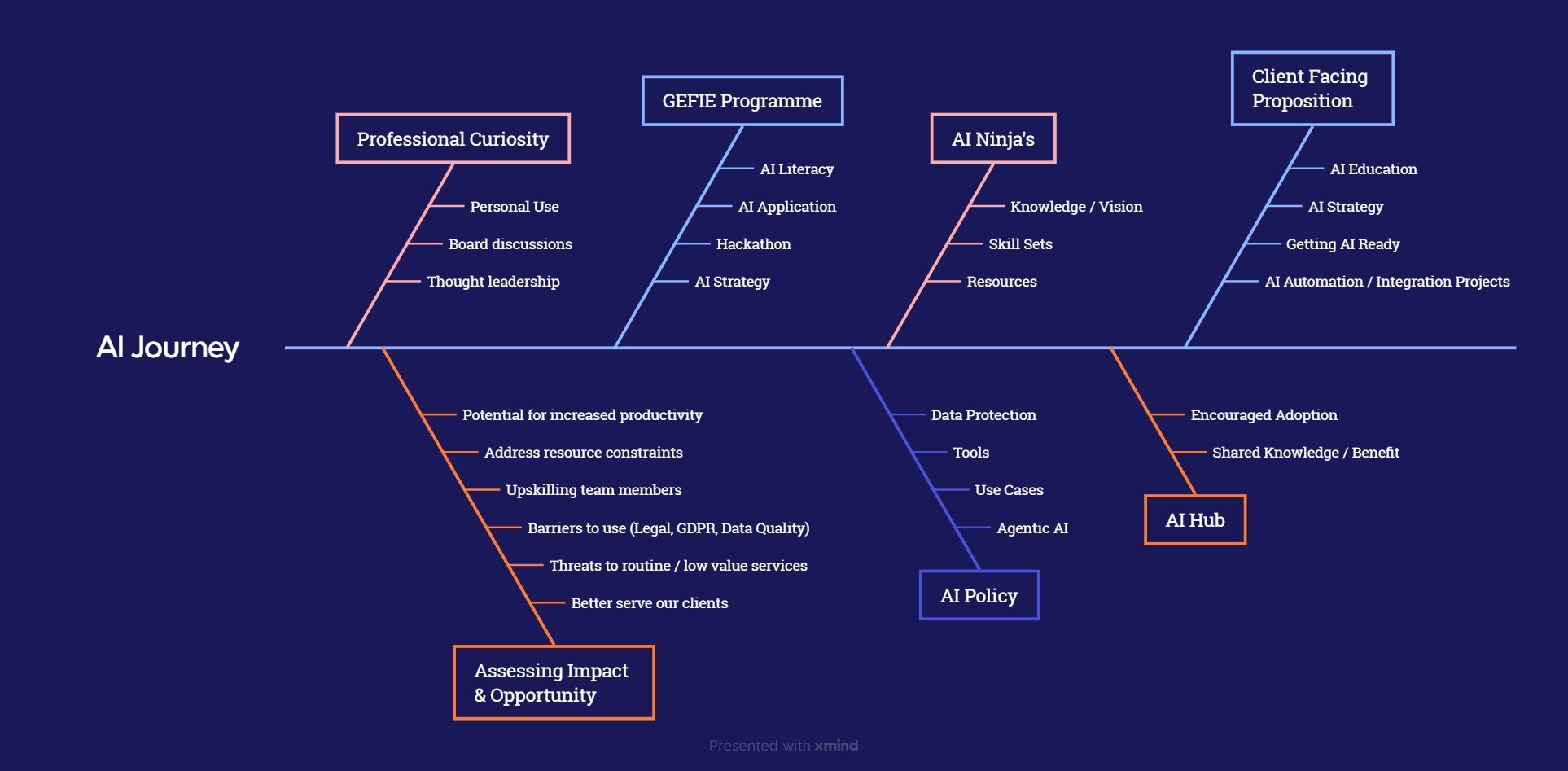
November 4, 2025When Hurst began exploring artificial intelligence three years ago, their first step was not a grand strategy but what Jo Gibson calls “professional curiosity.” Like many firms, they saw headlines about AI reshaping professional services, felt both excitement and anxiety, and asked the essential question: what does this mean for us?
That question led to a structured, firm-wide transformation. With guidance from consultancy Dixon AI, Hurst went from initial experiments to becoming one of the UK’s most AI-literate accountancy practices – embedding intelligent tools into daily operations, building internal capability, and launching new client offerings. Its journey provides a model for other firms navigating the same shift.
Building confidence through literacy
Hurst’s starting point was cultural, not technical. Early discussions revealed a broad spectrum of opinion: some employees were enthusiastic about AI’s potential; others feared data risks, compliance issues, or job displacement. Rather than outsource the issue to IT, the board decided that everyone—from support staff to partners—needed a baseline understanding of what AI is and how it works.
Working with Dixon AI, Hurst enrolled the whole firm in a foundational literacy stage. This was the first module of Dixon AI’s GEFIE program - an accelerator designed to help professional firms ’get urgent around AI’ and ensure practical and durable implementation. The aim was not to make data scientists out of accountants, but to demystify terms like ’large language model’, ‘GPT’, and ‘agent’, and to show how these tools could enhance, rather than replace, professional judgment.
From experiments to impact
Dixon AI’s consultants guided Hurst through a series of hands-on workshops where staff explored AI tools, brainstormed solutions to real bottlenecks, and then built their own solutions. Rather than asking, “What can this technology do?” teams asked, “Where are our inefficiencies?” and “Could AI make this easier?”
This led to a range of quick-build prototypes, or ’minimum viable products’. One example was a personal tax-planning GPT, created by Gibson in under an hour. The tool automates calculations and scenario comparisons for remuneration planning, drawing on live HMRC data. Other teams built “bots” for HR queries, private-equity research, and internal communications.
To sustain momentum, Hurst formed an ‘AI Ninja team’ — a cross-department group given time each quarter to explore, test and refine tools. The firm also built an internal AI Hub, a central library of approved prompts and GPTs within Microsoft Teams. This made AI resources accessible to everyone and encouraged peer-to-peer learning.
The Hurst AI journey
Policy, governance and the human role
Alongside experimentation came structure. Hurst’s leadership recognized that innovation must be balanced with safety. It developed an AI policy built around data sensitivity: everyday information could be used with open tools like ChatGPT; client data was confined to secure enterprise systems such as Microsoft Copilot.
This balance between empowerment and control reflects Dixon AI’s wider philosophy. As Footman notes, “AI is not a technology problem—it’s a people challenge.”
Their Purpose → Execution → Judgment framework captures this idea.
- Purpose: start with a clear business objective, such as improving efficiency by 10 per cent.
- Execution: using AI tools where appropriate, build a solution to meet your purpose.
- Judgment: apply human expertise to review and interpret the result. If needed, refine and iterate on your solution.
For Hurst, this model reinforced that technology is only as effective as the professionals who use it. AI became an assistant, not an authority.
Reaching “Level 3”: An embedded AI organization
Rob Dixon describes AI adoption as a three-level maturity curve.
- Level 1 – Awareness: leadership buy-in and commitment to upskilling.
- Level 2 – Literacy and Experimentation: safe exploration and small-scale pilots.
- Level 3 – Embedded Capability: AI integrated into strategy, governance and client service.
Hurst has now reached Level 3. The firm’s most AI-literate 10 per cent build tools; the other 90 per cent use them confidently in their work. New hires receive AI training as part of induction, and continuous education keeps the whole team current.
The benefits are tangible: repetitive manual tasks are reduced, internal queries are answered instantly, and teams can produce faster, data-driven insights for clients. The experience has also opened new commercial opportunities, with Hurst now advising clients on how to develop their own AI strategies.
Lessons for the profession
Hurst’s experience highlights several lessons for accountancy firms:
- Start with people, not software. AI success depends on literacy, culture and leadership example.
- Experiment safely. Use sandbox environments to build confidence before embedding tools.
- Develop clear governance. Policies should protect data without stifling innovation.
- Encourage collaboration. Mix tech-curious staff with experienced professionals to balance creativity and judgment.
- Think long-term. AI integration is not a one-off project but a continuous process of learning and improvement.
As Gibson concludes, “AI is just another tool—like Excel once was—but how we empower people to use it will define its impact.”
For accountancy firms still wondering how to begin, the message from Hurst and Dixon AI is simple: get curious, get educated, and get started.